How to Curl with a Straightener Long Hair: A Complete Guide for Flawless Curls
Learning how to curl with a straightener long hair means mastering a simple twist technique. Start by clamping a section of hair about 6 inches from the roots. Then, rotate the straightener 180 degrees and slowly glide it down the hair length.
This method creates natural-looking curls without needing a curling iron or extra tools. Just make sure to use the right heat setting for your hair type to avoid damage.
Protect your hair using a heat protectant spray first. It should shield your hair from heat up to 450°F. This product also keeps your hair smooth.
Choosing a straightener with narrow, smooth plates helps you get tighter curls. Wider plates create loose waves. Keep your sections small, around 1 to 2 inches wide.
So the curl forms evenly and lasts longer. It usually takes 30 to 45 minutes to curl all your long hair properly.
Key Takeaways
- Use small 1-2 inch hair sections for even, lasting curls.
- Pick your straightener plate size to control wave tightness.
- Set heat below 300°F for fine hair and up to 410°F for coarse hair.
- Apply a heat protectant to prevent damage and reduce frizz.
- Clamp hair 6 inches from roots and twist the iron 180 degrees.
- Glide straightener down hair slowly to form defined curls.
How to Curl Long Hair with a Straightener Step-By-Step
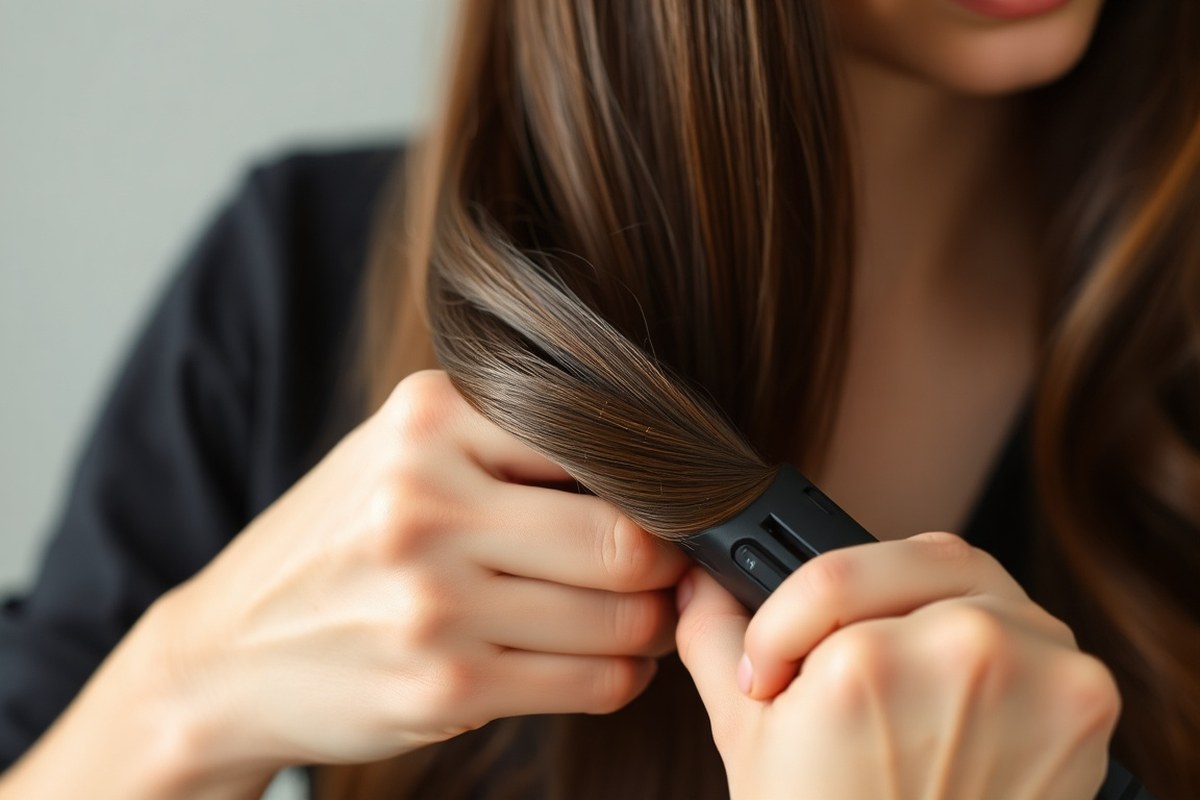
Curling long hair with a straightener needs control and patience. You section your hair, clamp small pieces, then twist the iron to shape curls. The right steps help you get smooth, lasting curls without damage.
Sectioning Long Hair for Best Results
Dividing your hair into sections makes curling easier and faster. Start by parting your hair down the middle or to one side.
Next, split your hair into top and bottom halves. This makes curling easier.
Clip the top half up so you can work with the bottom pieces first. Use small hair sections about 1 to 2 inches wide.
This helps heat cover each part evenly. Small sections give the best curl shape.
Clamping and Twisting Technique Explained
Hold the straightener at a slight angle away from your face. Clamp the hair about 6 inches from the roots to avoid heat damage to the scalp.
Grip the hair with the straightener, then twist it 180 degrees toward your curl direction. This turning shapes your hair smoothly without kinks. It helps form the curl evenly.
Gliding the Straightener and Curling Motion
After twisting, slowly glide the straightener down the hair shaft. Glide at a steady pace to let heat set the curl evenly without burning the hair.
Let go of the clamp near the ends to keep hair tips straight for loose waves. Clamp all the way for tighter curls.
Choose based on the look you want. Use a light hairspray to set curls right after styling.
Follow these steps to curl your long hair with a straightener:
- Section your hair into manageable parts, clip the top half up.
- Take a 1-2 inch wide section from the bottom half.
- Clamp the straightener 6 inches from the roots at a slight angle.
- Twist the straightener 180 degrees toward the curl direction.
- Slowly glide the straightener downward, keeping the twist steady.
- Release the hair at the ends for loose waves or clamp fully for tighter curls.
- Repeat for all sections, then finish with a light spritz of hairspray.
Choosing the Right Temperature and Plate Size for Your Hair

Choose the right temperature for curling long hair to avoid damage. Fine or bleached hair needs lower heat to protect weak cuticles. Coarse or virgin hair requires higher temperatures to hold curls well.
Plate width also affects your curl results. A medium-sized plate, about 1 to 1.5 inches wide, works best for long hair. Large paddle plates don’t curl well and hair won’t wrap tightly around them.
Use this table to pick your temperature setting. Match plate size to your hair type and health. Choose settings carefully to protect your hair.
| Hair Type | Temperature Range (°F) | Why This Works |
|---|---|---|
| Fine, bleached, or chemically processed | 280, 360 | Low heat protects the fragile cuticle and sets curls gently |
| Medium thickness, color-treated | 300, 390 | Enough heat reshapes keratin without stripping hair color |
| Coarse or virgin hair | 370, 410 | Higher heat penetrates thick hair to hold curls effectively |
The heat setting depends on how your hair feels and looks after curling. Start at the low end and raise it if curls don’t hold. For really stubborn coarse hair, 400°F might be needed but be sure to use heat protectant.
The plate width matters because a 1, 1.5 inch iron holds heat and curls long hair well. Smaller plates take longer and may break hair if you try to curl large sections. Avoid paddle irons as they are hard to twist into curls.
Always use a heat protectant spray before curling to reduce damage and help curls stay longer.
Preparing Long Hair to Curl with a Straightener
Prepare your long hair by washing, drying, and protecting it before curling with a straightener. Use the right products to avoid heat damage and help your curls last. How you prep your hair affects your curl’s smoothness and strength.
Washing and Drying Tips Before Curling
Wash your hair two days before curling for the best hold. Hair that’s too clean can be too soft, making curls fall faster. Hair washed four days ago might be too oily to style well.
Always dry your hair completely before using a flat iron. Damp hair can burn and frizz when heated.
So towel dry and let it air out or blow dry completely. Avoid curling wet hair to protect it from damage.
Try to detangle your hair gently with a wide-tooth comb after washing. This helps avoid uneven curls caused by knots or tangles.
Selecting and Applying Heat Protectants
Choose a heat protectant that shields hair up to at least 450°F. This protects strands from the high heat needed to curl long hair effectively. Hairitage Play It Cool Heat Protectant offers up to 450 degrees of protection.
Spray or apply the heat protectant evenly all over your hair before you curl. Make sure every section gets coated well. Focus more on ends.
Ends dry faster and are more fragile. This protects your hair from breakage and frizz.
- Use a thermal spray or cream made for heat protection
- Apply to dry hair, not wet
- Allow the protectant to dry for 1 to 2 minutes
- Reapply if you curl your hair multiple times
- Don’t skip the ends, they’re the most sensitive
Using a good heat protectant lets you style with confidence. It creates a shield that prevents curls from frizzing or burning during heat styling.
Additional Styling Primers and Products
Use a light styling mousse or curl enhancer before curling to add texture and grip. This helps the curls hold longer and look fuller on long hair. Avoid heavy products that weigh hair down or make it slick.
Consider a detangling spray if your hair tends to knot or break. It makes sections easier to handle and helps create even curls. Serums or oils can smooth ends but apply them sparingly to avoid greasiness.
Use a small amount of product, too much can make the curls limp or sticky. Experiment with your hair type and the curl style to find what works best for you.
Types of Curls and Waves You Can Create with a Flat Iron
You can create several curl shapes with a flat iron on long hair. Soft beachy waves come from curling vertical sections of hair slowly.
Twist the iron slightly as you pull it down each time. This technique helps create natural-looking waves you can wear every day.
For tighter, more defined curls, clamp a 1-inch section near your roots. Turn the iron halfway backward or forward, then glide it smoothly downward without stopping. This motion sets the curl firmly.
Voluminous curls happen when you curl horizontal sections. Hold the iron at the root of your hair securely. Rotate the iron away from your face smoothly.
Then, pull it down in one steady motion. This gives your hair bounce and body.
To loosen or reshape curls, run your fingers gently through your hair after it cools. Or, lightly brush the ends with a wide-tooth comb. Avoid brushing too soon or too hard, since curls can lose shape and frizz.
You can also loosen curls with a little heat. Use a flat iron or blow dryer on a low setting. Pass it lightly over your curls to loosen them up.
This softens the curls for a relaxed look. Take extra care not to overheat, which can damage long hair.
For flick-style curls, try turning the iron quickly at the ends to flick your hair outward. This suits casual looks. Curling inward toward your face gives a polished, framed effect.
Using a straightener with rounded edges helps smooth curls and prevent kinks. A plain flat iron can create curls, but one with curved plates works better. Keep the iron moving steadily to avoid burning or uneven shaping.
Section size changes your result too. Thin sections produce smaller, tighter curls, while wider ones yield loose waves. Adjust depending on your style and how your long hair naturally behaves.
Common Mistakes and How to Fix Them When Curling Long Hair
Curling long hair with a straightener can get tricky without the right technique. Common mistakes cause frizz, limp curls, or uneven waves that fade quickly. Avoiding these errors takes a few simple fixes you can use every time you style.
One big mistake is using the wrong heat setting for your hair type. Fine hair needs lower heat around 300°F to 350°F. Thick or coarse hair can handle heat from 375°F to 400°F. Use a good oil-based heat protectant to prevent damage.
It helps keep your hair safe while styling. Always spray a heat protectant before curling to avoid dryness and breakage.
Another frequent problem is holding the straightener on the hair too long. This causes heat damage and frizz.
Glide the flat iron smoothly, twisting and sliding for 5 to 8 seconds per section. Holding too long stiffens the hair and creates uneven curl shapes.
- Use a wide-tooth comb to detangle before curling to prevent snagging.
- Keep curls uniform by working with small, equal-sized hair sections.
- Avoid rushing; letting the iron glide smoothly shapes better curls.
- Don’t skip cooling your curls for 2 to 3 minutes, they set the shape better.
- Apply a lightweight leave-in conditioner to reduce frizz and add shine.
- Lift roots with a spray for volume before curling long hair.
- Mist finished curls with a sea salt spray to add texture and definition.
Uneven curls often come from twisting the straightener inconsistently or using uneven section sizes. Measure each segment at about 1-inch wide. Twist the iron in the same direction for uniform curls.
Mixing curl directions gives a messy look. So stick to one pattern unless you want a tousled wave.
Frizziness signals your hair is dry or overheated. Using a hydrating leave-in conditioner can smooth flyaways and protect the strands. Curls may look limp when you curl the ends too much.
Try skipping the ends to keep your curls bouncy. This helps your curls hold better.
Leaving the bottom 1 to 2 inches straight gives a natural bounce. Also, try shining serum lightly on dry curls to revive softness.
Let curls cool completely before touching or brushing to keep them intact longer.
How Hair Type Affects Curling Techniques and Product Choices
Curling long hair with a straightener changes based on your hair’s texture, thickness, and damage. Adjust your temperature, technique, and products to protect hair and get the style you want. Using the right heat and method helps curls hold better without causing harm.
Fine or Thin Long Hair Tips
Fine hair needs lower heat to avoid damage. Keep your straightener below 300 degrees Fahrenheit to prevent breakage. Use a lightweight heat protectant spray that won’t weigh hair down.
Wrap small sections of hair around the straightener, moving slowly for softer curls. Don’t hold the heat in one place longer than 4 to 5 seconds. This avoids extra stress on delicate strands.
Medium Texture and Colored Hair Considerations
Medium or colored hair benefits from moderate heat and good protection. Set your iron between 310 and 350 degrees Fahrenheit, enough to curl without stripping color. Choose a heat protectant with moisturizing ingredients to help keep your hair shiny.
Work in medium-sized sections to create smooth curls without frizz. Avoid going over the same part more than twice to keep hair from drying out. Colored hair may need extra conditioning treatments after styling.
Coarse or Thick Hair Adjustments
Thick or coarse hair needs higher temperatures for curls to form and last. Set your straightener between 350 and 400 degrees Fahrenheit.
Use a strong heat protectant to shield your hair from damage. Consider one that adds moisture and reduces frizz.
Grab bigger sections to style faster but hold the iron steady for 6 to 8 seconds. Thick hair takes longer to heat through, so patience helps create defined curls. You might repeat the curling motion once per section for tighter waves.
Here’s a quick guide for temperature and technique by hair type:
| Hair Type | Temperature (°F) | Section Size | Heat Hold Time | Recommended Product |
|---|---|---|---|---|
| Fine/Thin | Below 300 | Small (0.5 inch) | 4-5 seconds | Lightweight heat protectant |
| Medium/Colored | 310-350 | Medium (1 inch) | 4-6 seconds | Moisturizing heat protectant |
| Coarse/Thick | 350-400 | Large (1.5 inch) | 6-8 seconds | Heat protectant with moisture |
Matching your heat and section size to your hair type makes curling easier. This balance helps curls hold better and avoids extra damage. Change product use based on the texture and how much moisture your hair needs.
Making Curls Last Longer and Maintaining Them All Day
Curls made with a straightener can last 3 to 5 days. You need to take good care of them to keep them fresh. Make sure to avoid heavy brushing or washing too often.
Using the right products helps reduce frizz and keeps your curls bouncy all day long. Light hairsprays with no aerosol create a good base before styling and help curls set better.
Timing matters when you pull your straightener through each section. Pulling slowly makes tighter curls. But rushing creates looser waves that don’t hold as long.
After curling, wait as long as possible before touching your hair. This lets your curls cool down and keeps their shape.
- Apply a heat protectant spray before curling to prevent damage
- Use a non-aerosol hairspray right before curling for better hold
- Let curls cool completely before touching or brushing
- Brush gently or use fingertips to separate curls without ruining shape
- Avoid heavy oils or creams that weigh hair down and cause droop
- Refresh curls with a light mist of water or curl refresher spray during the day
- Sleep with hair loosely tied or on a silk pillowcase to reduce friction
Try spraying a salt spray after curling hair that stays straight. This helps curls hold better. It adds texture and grip to hair strands.
It adds texture and grip, helping curls look fresh longer. When curls start to droop, gently scrunch them with your fingers.
You can also spray a little water on them. This will help bring back their bounce.
Keeping curls looking fresh might take some trial and error with products. Some cost $10 to $20 but last a full day. Try smaller sizes or samples before buying.
Use less product to keep your curls light and lively. Too much product can make curls stiff or sticky. Less is usually better for natural movement.
Time Needed and Realistic Expectations for Curling Long Hair
Curling long hair with a straightener usually takes 20 to 40 minutes. This range depends on hair thickness, how tight you want the curls, and your skill level. Starting with dry, detangled hair makes the process smoother and quicker.
Long hair needs sectioning into smaller parts for even curling. You might use 1-inch sections to wrap around the straightener easily. Smaller sections take more time, but they create curl lasting longer and looking neater.
Compared to short or medium hair, long hair curls require more time and patience. For short hair, you might curl large chunks faster. With long strands, curl each piece fully from root to end.
Take about 20 seconds per section. Work methodically to get even curls throughout.
Use heat protectant spray before curling. It helps manage hair and speeds heat transfer. This saves time and protects hair from damage.
Working with preheated straighteners saves minutes, avoiding the need to reheat often. Also, keep moving the straightener smoothly to avoid burning hair and get even curls.
Clamp the straightener near your hair ends. Slowly twist it upward to curl. This creates natural waves quickly.
Use wider sections or twist the straightener less for looser curls. This makes your curls softer and less tight.
For tighter curls, smaller sections and slower movement work better but take longer. Moderate heat settings between 300°F and 375°F suit most long hair types without causing damage.
Curl only the visible outer layers if you wear hair down. This saves time when styling. Focus on what people see most.
The curls underneath will show less, letting you skip some inner sections during busy mornings. This trick saves up to 10 minutes depending on your hair volume.
Step-by-Step Action Plan for Curling Long Hair with a Straightener
Follow these steps to curl your long hair quickly and effectively. Check each result before moving on.
- Before you start: Wash and dry your hair completely to avoid damage. Your hair should feel dry and smooth to touch.
- Preparation phase: Apply a heat protectant spray evenly through your hair. You’ll see a fine, even mist and feel no wet spots.
- Heating up: Set your straightener to the right temperature based on your hair type. The plates should heat up in 1 to 3 minutes and hold steady.
- Sectioning: Divide your hair into small sections using clips. Each section should be about 1 to 2 inches wide and easy to hold.
- Curling: Clamp the straightener near the roots and gently twist it down the strand. The curl should form smoothly without pulling or snagging.
- Setting curls: After curling a section, hold it in your palm. Let the curl cool for 10 to 15 seconds before releasing. The curl will feel firm and stay in shape.
- Finishing touches: Once all sections are curled, use a light hairspray to hold them in place. You’ll notice your curls stay bouncy but not stiff all day.
- Maintenance: Avoid touching your curls too much to prevent frizz. Your curls should maintain their shape for several hours.
Frequently Asked Questions
Can You Use Any Straightener to Curl Long Hair?
Not all straighteners work well for curls. Choose one with narrow, rounded plates to create smooth, natural curls without sharp creases.
How Can You Prevent Heat Damage When Curling Long Hair?
Use a heat protectant spray before styling. It shields your hair from the high temperatures and reduces breakage while keeping curls shiny.
Does Hair Length Affect the Size of Curls Made with a Straightener?
Yes, longer hair generally suits looser, bigger curls. Very tight curls look better on shorter hair or layered cuts.
Is It Better to Curl Hair in Sections or All at Once?
Curling in sections gives more even and lasting curls. Work with 10 or fewer sections for quicker styling.
What Type of Hair Products Help Curls Stay in Place?
Light hold hairsprays work best. Avoid heavy products that weigh curls down or make hair stiff.
Can You Refresh Straightener Curls Without Re-Curling?
Spritz curls lightly with water or curl refreshing spray. Then scrunch and let them air dry for bounce back.
The Bottom Line
Curling your long hair with a straightener gets easier with practice and proper care. Start today with clean, dry hair and the right heat setting. Remember to protect your hair and enjoy your new curls all day long.