What’s a Good Flat Iron: Complete Guide to Choose Your Best Hair Straightener
What’s a good flat iron depends on your hair type and styling needs. The best irons have adjustable heat settings to protect your hair while smoothing it.
Plates between 1 and 1.5 inches work well for most hair lengths. Too wide plates make styling near your face harder.
Plate material affects hair health during styling. Titanium heats fast but can be harsh on fine hair.
Ceramic gives gentle, even heat for damaged hair. Choose a flat iron with multiple heat settings, topping out near 450 degrees Fahrenheit.
Quick heat-up saves time, and a swiveling cord prevents tangles. Some irons keep a steady heat to protect hair, like Ghd’s model locking at 365 degrees. Start with lower heat and test your hair’s reaction before going hotter to avoid damage.
Key Takeaways
- Choose plate size based on hair length: 1-inch for short, 1.5-inch for most hair.
- Ceramic plates suit fragile or damaged hair; titanium suits thick or coarse hair.
- Use irons with adjustable heat, ideally maxing out at 450 degrees Fahrenheit.
- Lower heat settings reduce damage but may need longer styling time.
- Look for features like fast heating and swivel cords for easier use.
- Flat irons with locked safe temperatures help protect hair health.
Which Flat Irons Work Best for Different Hair Types?

Fine hair needs a gentler touch with lower heat to avoid damage. Ceramic plates at around 250°F to 300°F work best for fine or fragile hair. Thick or curly hair requires stronger heat and more durable plates like titanium to straighten effectively.
Curly and coarse hair needs high heat, often up to 400°F. Titanium plates handle wear and keep heat steady. This helps straighten hair better. Tourmaline plates suit nearly all hair types and help reduce frizz by creating negative ions.
Damaged hair needs gentle heat and protection. Ceramic plates help. Look for low minimum heat settings to keep strands safe.
Heat setting choice depends heavily on hair type. Fine hair, with its delicate strands, should never go above 300°F to prevent burning or brittleness.
Thick or curly hair often needs 350°F to 400°F to straighten well. Always start at a lower heat and increase slowly if needed to avoid extra damage.
| Hair Type | Plate Material | Recommended Heat Range | Example Flat Iron | Price Range |
|---|---|---|---|---|
| Fine, Fragile | Ceramic | 250°F, 300°F | CHI Original Pro | $50, $100 |
| Wavy to Medium | Tourmaline | 300°F, 365°F | Ghd Platinum+ Styler | $279 |
| Thick, Coarse, Curly | Titanium | 350°F, 400°F | BaBylissPRO Nano Titanium | $160, $180 |
| Damaged Hair | Ceramic with Mineral Infusion | 250°F, 300°F | T3 SinglePass StyleMax | About $180 |
The right flat iron saves you time. It can cut straightening to 10 minutes. This especially helps if your hair is thick.
Wider plates work well for long or dense hair. They can be hard to use on short or fine hair.
Consider your hair type before choosing. Matching the plate width to hair thickness helps you style faster and with less damage.
Irons limited to high heat, like those starting at 365°F, aren’t safe for fragile hair. Good flat irons include adjustable heat settings for flexibility. Five heat settings let you pick the best temperature.
This fits different hair types. You find the safest, most effective heat this way.
How Do Plate Materials Affect Hair Health and Styling?

Choosing the right flat iron plate material affects how fast it styles. It also impacts how gentle the tool is on your hair. Your hair health depends on this choice.
Ceramic, titanium and tourmaline plates each offer different benefits and tradeoffs. Different plates heat hair in different ways.
They reduce frizz to different levels. The best choice matches your hair type and styling goals.
Ceramic Plates: Gentle Heat Distribution
Ceramic plates spread heat evenly and gently. This helps avoid hot spots that burn hair or cause uneven straightening.
Because ceramic heats slower than titanium, it can lose warmth after a few passes. That means you might need multiple strokes per section. This is fine for thin or fine hair that needs lower heat (usually 250 to 350°F).
Ceramic plates are affordable, usually under $100 for a good model. They work best for people who want smooth, shiny hair without high heat damage risk.
Titanium Plates: High Heat and Durability
Titanium plates heat up quickly and hold steady temperatures up to 450°F. They work well on thick or coarse hair that needs high temps for lasting straightness.
This metal is very durable and lightweight. So your flat iron lasts longer and feels easier to use. The consistent heat helps straighten hair faster, meaning less exposure to heat overall.
Titanium heats up very fast and high. This can cause more damage to your hair.
You must watch heat settings carefully to avoid this. These irons usually cost more, often over $100.
Tourmaline Plates: Frizz Reduction and Shine
Tourmaline is a mineral crushed and mixed with ceramic for plates. It releases negative ions that smooth hair cuticles and fight frizz.
This makes hair look shinier and less static-prone right after styling. Tourmaline-coated plates heat evenly and generally need less heat than plain ceramic or titanium.
These flat irons usually cost more money. They can be worth buying for frizz control.
They also help improve hair shine a lot. Many popular travel irons feature tourmaline ceramic plates for their gentle styling and smooth glide.
| Plate Material | Heat Range (°F) | Pros | Cons | Cost & Size Examples |
|---|---|---|---|---|
| Ceramic | 250, 410 | Even heat, gentle on hair, affordable | Heat can dip, slower heating | Remington Pro, $; 1-inch plates |
| Titanium | 300, 450 | Fast heating, durable, steady heat | Can get too hot, pricier | Kristin Ess 3-in-One, $$; 1.25-inch plates |
| Tourmaline | 250, 460 | Reduces frizz, adds shine, smooth glide | Usually higher cost | Conair InfinitiPRO, $; 1-inch plates |
The right choice depends on your hair and styling habits. Ceramic suits low-heat users and fine hair.
Titanium fits those who want quick, high-heat styling on coarse hair. Tourmaline is top for fighting frizz and adding shine on most hair types.
Use the lowest effective heat setting to protect hair no matter which plate material you pick.
What Plate Size Is Ideal for Your Hair Length and Styling Needs?
Choosing the right plate size depends on your hair length. It also depends on the style you want. Smaller plates work best for short hair and detailed styling.
Larger plates help speed up styling on thick or long hair. Picking the right width helps you style faster and with better precision.
Best Plate Sizes for Hair Lengths
For short hair like a pixie cut or bob, 1-inch plates are ideal. They let you get close to the roots and manage small sections easily. Medium-length hair, such as shoulder-length cuts, works well with 1 to 1.25-inch plates, balancing speed with control.
Long hair needs wider plates of 1.5 inches up to 2 inches to cover more surface area. This reduces your styling time, especially if your hair is thick or coarse. Plates larger than 2 inches can be hard to control and may cause uneven straightening.
How Plate Width Affects Styling Speed and Detail
Narrow plates mean you style smaller sections at a time. This makes them perfect for curls, waves, or bending strands. They give you better precision around the hairline or bangs.
Wider plates heat more hair in each pass, making straightening quicker for long or thick hair. But they can be bulky for detailed work or short lengths, causing you to miss roots.
Choosing Plates for Thick or Coarse Hair
Flat irons with plates between 1.5 and 2 inches handle thick, coarse hair best. The larger surface heats the hair uniformly and lets you straighten bigger sections. This saves time and reduces heat exposure per strand.
Titanium plates work best for very thick hair. Larger widths heat up faster. Ceramic plates are better for fine hair as they give gentler heat.
Steps to Pick Your Ideal Plate Size
Measure your hair length first. Short is ear to chin. Medium is chin to shoulders.
Long is below shoulders. Think about how much time you want to spend styling. Also, decide if you want curls or waves.
Here’s a quick list to guide your choice:
- Short hair: 1-inch plates for detail and easy root access
- Medium hair: 1 to 1.25-inch plates for balance of speed and control
- Long hair: 1.5 to 2-inch plates for faster straightening of large sections
- Thick/coarse hair: wider plates with titanium for high heat and efficiency
- Curly or detailed styles: narrow plates help create curls and waves better
Try to avoid plates wider than 2 inches. They’re harder to control and may overheat some areas.
Styling fast and thick hair? Pick the widest plates you can handle easily.
Watching for Flat Iron Results and Errors
Good results show smooth, evenly straightened hair with little need for repeated passes. You’ll save time when heat hits the hair quickly and evenly over larger sections.
Struggling to get close to your roots? Your plates might be too wide.
If you hold the iron over 10 seconds, raise the temperature or use smaller plates. This helps avoid damage.
How Does Heat Setting Choice Impact Hair and Results?
Choosing the right heat setting protects your hair. It also improves your straightening results. Use the lowest setting that works well for your hair.
Fine or damaged hair usually needs lower temperatures around 250°F or less to avoid damage. Medium to thick hair straightens best between 250°F and 350°F. For thick, coarse hair, set the iron between 350°F and 400°F to smooth the cuticle properly.
Multiple heat settings let you adjust heat easily. This helps based on your hair’s condition each day. You get better results without damaging your hair.
You might need less heat if your hair is already straightened or recently treated. Using too much heat can cause breakage or split ends.
It may also fade hair color over time. Adjusting heat makes styling safer for your hair.
To avoid heat damage when straightening often, always start with the lowest effective temperature. Use a heat protectant before you start. A product protecting up to 450°F offers good coverage.
Limit passes on the same section to one or two times. This lowers heat exposure a lot. It helps keep your hair healthier and less damaged.
A flat iron with temperature control makes heat adjusting simple. Models like GVP Ceramic Titanium or FHI HEAT are good examples. They give precise heat for safer styling.
Some flat irons have heat settings from 200°F to 450°F. These options fit all hair types and styles well. You can find the best heat for you. Avoid irons without adjustable heat controls.
They might be too hot or too cool for your hair. This can cause damage or poor styling results.
Stick to these heat settings as a quick guide: less than 250°F for fine, fragile hair. 250°F to 350°F for medium thickness; 350°F to 400°F for coarse or thick hair. Raising the temperature above 400°F can cause damage and isn’t usually needed for straightening.
Always let the flat iron heat fully before use. Test it on a small hair section first. This step helps avoid burning or uneven heat on your hair.
What Key Features Make a Flat Iron Easy and Effective to Use?
A 360° swivel cord makes using a flat iron much easier. It prevents the cord from tangling while you move your wrist or change angles.
This feature helps when you style your hair by a mirror. It also works well if you style your hair on the go.
Fast heat-up saves you time every day. Aim for a flat iron that reaches 99% of its set temperature in about 30 seconds. Waiting longer can be frustrating, especially during busy mornings or quick touch-ups.
Safety features like automatic shutoff protect your home and hair. A flat iron with auto shutoff activates after 30 to 60 minutes.
This feature offers peace of mind while styling. This prevents accidents if you forget to unplug it or leave it on by mistake.
Look for customizable heat settings so you match the iron’s temperature to your hair type. Many flat irons offer ranges from about 280°F to 430°F. Lower settings work for fine, thin hair. Higher for thick, coarse hair.
Comfort also matters. A flat iron with an ergonomic grip and a long swivel cord makes styling less tiring.
Choose one with a cord at least 6 feet long. Otherwise, you might struggle near outlets or while moving around.
Some irons use negative ions and infrared heat to cut frizz. They also help protect your hair’s shine.
While these add costs, many find the smoother results worth it. Brands like Paul Mitchell Protools offer these extras.
The T3 SinglePass Flat Iron has a swivel cord and auto shutoff. It also offers adjustable heat for easier, safer styling.
The BaBylissPRO Flat Iron heats up fast but starts hot. It works better for thick hair types.
Look for a flat iron with a 360-degree swivel cord. Fast heat, auto shutoff, adjustable heat, and comfort also matter. Missing any of these can cause frustration, accidents, or poor results.
Don’t overlook the cord length; a short cord limits your styling spots and comfort.
Which Flat Irons Offer the Best Value for Each Budget Range?
Flat irons under $50 usually focus on basic ceramic plates. You get decent straightening, but the heat might not spread evenly.
Most budget irons lack advanced features. So expect to spend more time styling and less gentle heat control.
Mid-range flat irons priced from $70 to $150 often offer titanium plates or nanoparticle tech. They heat faster and glide smoother without snagging hair. This price range often includes extra features like wider temperature ranges.
You can find versatile designs too, such as irons that also curl hair. These features add flexibility for different styling needs.
Premium flat irons costing $200 or more justify their price with smart tech and hair-friendly materials. These irons often include temperature precision, frizz reduction, and long-lasting styling effects. Some models infuse ingredients like aloe to keep hair smooth during styling.
| Model | Price | Plate Type | Standout Features |
|---|---|---|---|
| Infinitipro by Conair Rainbow | $44.99 | Titanium | Good glide, heats quickly, avoids snagging hair |
| GVP Ceramic Titanium Simple | Under $30 | Ceramic Titanium | Simple, effective, works on all hair types |
| BaBylissPRO | $130+ | Titanium | Powerful straightening, smooth finish |
| T3 Lucea 1-Inch | $200 | Advanced ceramic | Aloe-infused, frizz control, temperature precision |
| Dyson Corrale | $500+ | Flexible manganese copper alloy | Wireless, controlled heat, reduces damage |
Budget flat irons under $50 can give you a basic straight look. You should check for even heating and smooth plates to avoid damage or snagging. These irons suit occasional use or short, thin hair.
The $70 to $150 range is worth picking for better materials and more heat options. You spend less time styling and get less hair stress.
Mid-range flat irons often have many heat settings. These settings usually go from low 200°F to over 400°F. This helps you style different hair types safely.
Premium irons charging $200 or more bring extra comfort and protection. They help maintain hair health while giving longer-lasting styles. Look for models that specify temperature control and special treatments like aloe infusion.
How to Use a Flat Iron Safely for Best Results?
Use a flat iron on clean, dry hair. Apply heat protectant first. It shields your strands from damage.
Sectioning your hair lets you work faster and ensures an even straightening. Adjust heat based on hair type to avoid damage.
Prepping Hair Before Styling
Begin with freshly washed hair that is fully dry. Using a flat iron on damp hair can cause steam damage and breakage. Brush through your hair to remove tangles, making straightening smoother.
Clean, dry hair absorbs heat evenly and responds better to styling. Avoid products that leave residue because they can build up on the plates, reducing performance. Also, check your hair for knots and smooth them out before starting.
Sectioning Hair Correctly
Divide your hair into sections about 1 to 2 inches wide for easier and quicker styling. Smaller sections mean better heat distribution and fewer passes with the flat iron. Use clips or hair ties to keep the rest of your hair out of the way.
Start with the bottom layers, clipping the top layers up and out of the way. Work your way up as you finish each section. This approach keeps your work organized and helps you not miss spots.
Applying Heat Protectant
Use a heat protectant spray or serum before applying heat to your hair. It forms a barrier that reduces heat damage and moisture loss. Apply evenly on damp or dry hair according to the product’s instructions.
Spray from root to tip, then comb through gently to spread the product evenly. Let it dry completely before using the flat iron. This step usually takes a minute or two but saves your hair from long-term damage.
Follow these steps for a safe and effective flat ironing session:
- Wash your hair and completely dry it using a blow dryer or air dry.
- Brush through to remove any knots or tangles.
- Apply a heat protectant product evenly throughout your hair.
- Divide your hair into sections 1, 2 inches wide and clip up the top layers.
- Set your flat iron to the appropriate temperature for your hair type (usually 300°F to 375°F). Avoid higher heat on fine hair.
- Starting from the bottom, slowly glide the flat iron down each section once or twice.
- Release the next section and repeat until all hair is straightened.
- Allow hair to cool before touching or styling further to set the look.
How Long Does It Take to Straighten Hair with Different Irons?
Plate width matters a lot for how fast you can straighten hair. A one-inch plate handles narrow sections, so you need more passes.
Wider plates, like 1.25 inches, cover more hair each pass. That means fewer passes and less time overall.
Heat also affects speed. Higher temperatures can tame stubborn curls faster but risk heat damage. Medium heat settings around 350°F work well for fine or damaged hair.
Thick or coarse hair might need 400°F or more. You don’t want to rush and go too high or you’ll risk ruining your hair.
Hair type and length influence timing a lot. Straightening short hair takes about 5 to 10 minutes with a one-inch plate. Medium-length hair often takes 10 to 15 minutes.
Long hair can take 15 to 30 minutes. Thick or coarse hair usually takes more time to straighten.
You need slower, careful passes to get it smooth. This applies no matter the hair length.
For example, thinning hair sections into about one-inch blocks helps heat spread evenly. Expect to do 4 or 5 passes per section with narrow plates. For wider plates, you might only need 2 to 3 passes.
How fast the iron heats up affects the total time, too. Fast heating irons save a few extra minutes at the start.
Fast straightening irons tend to have good temperature control and 1.25-inch plates. These irons let you style big sections safely without going back over hair repeatedly.
Your goal is smooth strands after just one pass per section. Your iron likely snags when you go too fast or use narrow plates.
Try separating hair into small sections that fit your plate width to avoid repeated passes.
Slow down when straightening thick or curly hair for best results. Going too fast can leave kinks or uneven spots. Using a moderate heat setting often means slower straightening but less damage.
Choosing a flat iron with small plates for long hair wastes time. You’ll clip and redo sections more often.
Keep timing realistic. Straightening long, thick hair takes at least 20 minutes with a smaller plate at medium heat. With wider plates and higher heat, it might drop closer to 15 minutes.
Short, fine hair can be done in under 5 minutes with a good one-inch plate iron. Knowing how long your hair takes helps you pick the right iron. It also sets your expectations correctly.
Are Cordless and Travel-Friendly Flat Irons Worth Buying?
Cordless flat irons usually hold charge for about 20 to 30 minutes. This allows quick touch-ups but may not suit full head styling. The Dyson Corrale is a full-sized cordless flat iron.
It lets you style more hair faster. It beats small travel-size irons in speed and coverage.
Travel flat irons often have lower wattage. So they heat up slower and might struggle on thick hair. Many travel irons stick to 1-inch plates and max temperatures around 400°F. For thicker or curly hair, this might mean more passes and longer styling time.
A good travel-friendly iron is lightweight, compact, and dual voltage for worldwide use. Look for plates around 1 inch for versatility and a carrying case. An automatic shut-off is key for safety when traveling.
Pick cordless if you want freedom from outlets and quick fixes on the go. Choose a model with a strong battery, at least 20 minutes runtime, and fast heat-up. You style your whole head often.
A full-sized cordless like Dyson’s fits better. Mini versions might slow you down.
Travel irons work well if you need a light, compact tool for trips. Prioritize models under 1 pound with dual voltage.
Expect to pay about $50 to $150, depending on brand and features. They fit well in carry-ons and hotel rooms but might not match full-sized power.
Your choice depends on hair type, styling habits, and travel frequency. For thin or medium hair and occasional use, travel irons provide convenience without big downsides. Thick or curly hair needs strong heat.
You can try cordless full-sized irons. Or stick with your regular one if power is key.
How to Maintain and Clean Your Flat Iron for Longevity?
Cleaning your flat iron plates after every few uses stops buildup and keeps hair smooth. Flat irons with ceramic or titanium plates need gentle care. This protects the heating elements from damage.
Handle them with care to keep them working well. Avoid using harsh chemicals or abrasive tools that could scratch the plates or expose hot metal.
Clean your flat iron plates once a week. Do it after using heavy products, like oils or sprays. This keeps the plates clean and safe for use.
Use a soft cloth with rubbing alcohol to clean the plates. Or try a mix of water and mild dish soap.
Dampen the cloth slightly to avoid soaking the iron. Wipe the plates carefully, avoiding moisture near the electrical parts or the hinges.
- Unplug and cool the flat iron completely before cleaning
- Use a soft microfiber cloth or cotton pad
- Apply a small amount of rubbing alcohol or mild soap solution to the cloth
- Gently wipe each plate until residue is removed
- Dry plates with a clean cloth to remove moisture
- Check the edges for chips or cracks to avoid hair damage
- Store the flat iron in a clean, dry place away from moisture
Cleaning like this costs only a few cents for rubbing alcohol or mild soap. But it protects your tool’s finish and heating elements. You’ll see your flat iron glide smoother after cleaning.
It will also heat more evenly after care. This helps you style faster and better. Leaving product buildup can cause uneven heat distribution.
This might burn your hair or damage the plates. Clean the plates regularly to avoid these problems.
Don’t soak or submerge your flat iron in water to prevent electrical damage. Never scrape the plates with metal or hard objects. Scraping can expose bare metal or break the surface.
Use gentle cleaning methods only to protect the plates. Replace your flat iron if the plates chip or crack.
Damaged plates can harm your hair and give poor results. It’s safer to buy a new flat iron.
What Common Flat Iron Mistakes Cause Poor Results or Damage?
One common mistake is using a flat iron on damp hair. This causes uneven straightening and frizz because the heat turns water into steam, damaging strands.
Wait until your hair is fully dry before you start. You can also let it air dry overnight for the best results.
Another issue is overheating your hair. Many people set the iron too hot, which risks burns and breakage.
For fine or damaged hair, keep the temperature under 300°F. Coarser hair can handle higher heat. But try to stay below 375°F to avoid flyaways and frizz.
Dragging a heavy or bulky flat iron too quickly can snag and pull hair. This hurts your strands and makes styling hard.
Use an iron that feels light and balanced for smooth, slow passes across your hair. It helps to section hair into smaller parts for better control.
- Don’t iron the same spot multiple times; just 2, 3 passes are enough
- Use a heat protectant spray to shield hair from damage
- Detangle hair fully before ironing to avoid snags and pulls
- Clean your flat iron regularly to stop buildup that catches hair
- Choose the right plate size to match your hair length and thickness
When your flat iron snags, stop and gently untangle the hair. Never force it through while the iron is hot.
Also, avoid styling wet hair this way as it’s more likely to stick and break. Regularly comb through your hair as you straighten to keep it smooth.
Start with the heat at its lowest setting. Increase it only if necessary to protect your hair.
Can Flat Irons Be Used for Curling or Other Styling Besides Straightening?
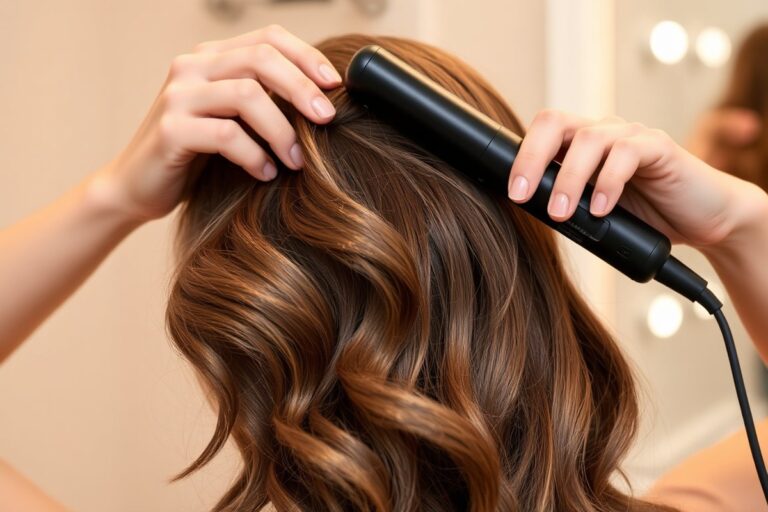
Flat irons with curved edges help you easily curl and wave hair. You can smoothly wrap hair around without pulling or snagging strands. For instance, the BaBylissPro Nano Titanium Dual Ionic Flat Iron reaches 450 degrees Fahrenheit and works well for curls thanks to its rounded plates.
Plate size matters for curls too. Smaller plates, around 1 inch wide, let you grab smaller hair sections. This helps create tighter, more defined curls.
Larger plates, like 1.5 inches or wider, work better for loose waves or bigger curls. Choose a narrow plate if your hair is short or fine. It offers better control while styling.
Heat your flat iron to a medium setting, between 350 and 400 degrees. This is the right heat range for curling hair. Start styling once it reaches that temperature.
Take a one-inch section of dry hair and clamp the iron near the roots. Twist the iron away from your face while slowly sliding down the hair.
Release the hair gently to see the curl form. Repeat with all sections for full curls.
For beach waves, take bigger sections of your hair. Wrap hair around the iron without twisting it all the way. This creates loose, natural waves.
Move quickly to avoid sharp bends. Let curls cool before brushing for softer waves.
Avoid heat above 400 degrees on fine hair to prevent damage. Use a heat protectant spray for safety.
Flipping your hair under is possible too. Clamp the flat iron near the hair ends. Then tilt your wrists inward or outward depending on which way you want the curl to flip.
Slowly glide the iron through the tips. This trick adds subtle volume and style without complete curling.
Some curling mistakes include pulling hair too fast or clamping too tightly. This can cause uneven curls or hair snagging. Practice on smaller sections first to get a rhythm.
Picking the right flat iron with curved edges helps your styling. Adjustable heat makes curling and waving your hair easier and safer.
Your Step-by-Step Plan to Choose and Use the Best Flat Iron
Follow these steps to find, use, and care for the right flat iron. You’ll avoid damage and get great results fast.
- Before you buy: Identify your hair type and length. This guides your choice of plate material and size.
- Day 1: Pick a flat iron with adjustable heat. Set it at the lowest effective temperature to protect your hair.
- Week 1: Test the flat iron on a small hair section. Check if it straightens smoothly without pulling or burning.
- Week 2: Practice different styling techniques like straightening or curling. Confirm the flat iron handles both well.
- Monthly: Clean your flat iron’s plates with a soft cloth and gentle cleaner. This keeps it working well longer.
- Ongoing: Avoid common mistakes like using too much heat or not using heat protectant. Watch for signs of damage.
- Before traveling: Charge cordless irons fully or pack a travel-friendly corded model. Try it out to ensure it meets your needs.
Frequently Asked Questions
What Temperature Is Safest to Use on Fine or Damaged Hair?
The safest temperature is usually below 365°F. Ghd irons lock at this level to reduce damage risk while still straightening well.
Are Ceramic Plates Better Than Titanium for Daily Use?
Ceramic plates generally suit daily use better. They heat evenly and are gentler on hair than titanium.
How Long Should a Quality Flat Iron Last with Proper Care?
Properly cared for flat irons can last 5 to 10 years. Cleaning the plates and storing them safely helps a lot.
Is It Better to Buy a Flat Iron with Adjustable Plate Size?
Adjustable plate size can fit different styling needs. If your hair varies, choose one with multiple plate widths.
Can I Use the Same Flat Iron for Both Curly and Wavy Hair?
Yes, most good flat irons work on both hair types. Adjust heat based on thickness for best results.
What’s the Average Weight of a Comfortable Flat Iron?
A comfortable flat iron usually weighs around 1 to 1.5 pounds. Lightweight irons reduce arm strain during styling.
Wrapping Up
Choosing the right flat iron depends on your hair type and styling goals. Start with a smart choice, then use and care for it properly. Try your new flat iron soon to see how much easier styling can be.